
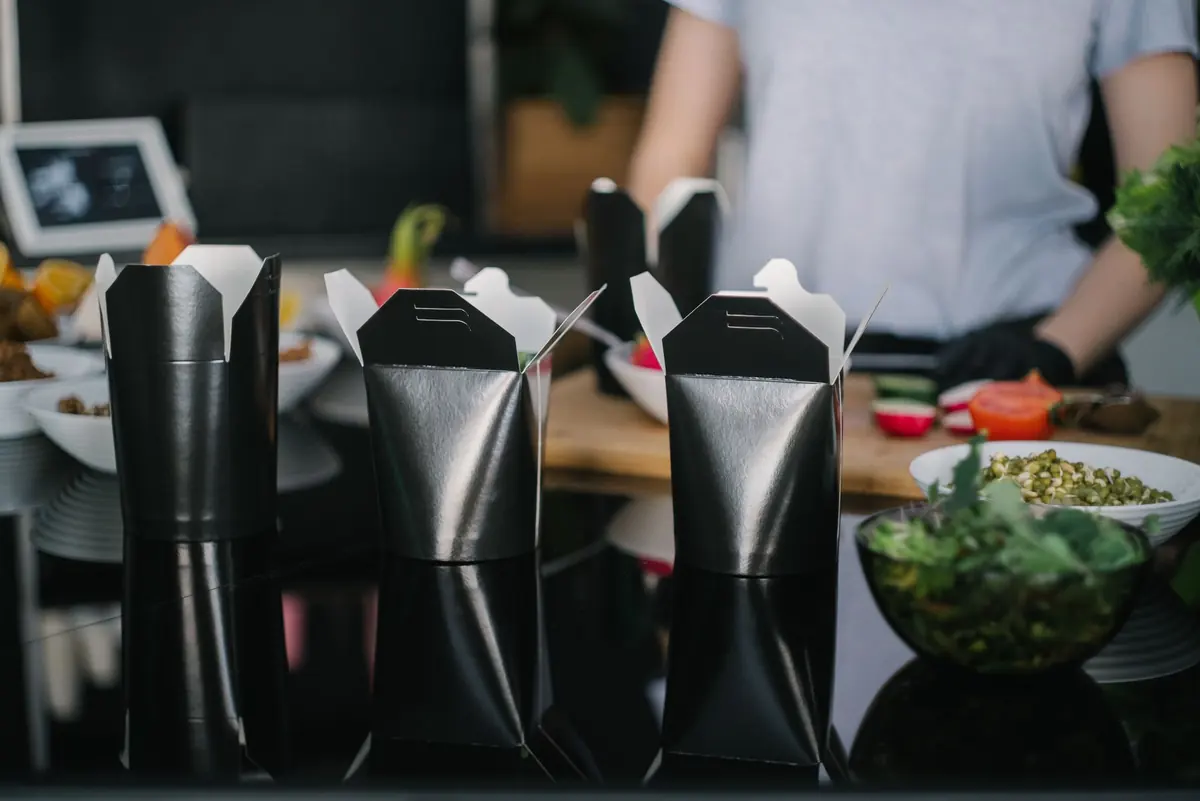
The same order can be excellent at a table and disappointing twenty minutes later on a kitchen counter. That is not the kitchen’s fault and it is mostly avoidable, because some things on this menu travel far better than others.
The short answer
Rice plates travel best. Wraps are good but on a clock. Anything fried is on a shorter clock. And the single highest-value thing you can say when ordering is sauce on the side — it costs nothing and it is the difference between bread and a wet paper towel.
Why food degrades in a bag
Two things happen on the drive, and understanding them tells you what to order without memorising a list.
The first is steam. Hot food in a closed container keeps releasing moisture, which has nowhere to go and condenses back onto whatever is nearest. That is what turns a crisp edge soft and a fresh pita limp.
The second is migration. Sauce moves into bread. Dressing moves into leaves. Neither is reversible, and both are on a timer that starts when the lid goes on.
What travels well
| Item | How it travels | Why | What to ask for |
|---|---|---|---|
| Rice plate | Very well | Rice holds heat and buffers moisture; meat stays moist under it | Sauce on the side |
| Kofta and grilled meats | Very well | Dense and forgiving; they were never crisp to begin with | — |
| Dips and bread | Very well | Dips are served cool anyway; only the bread is at risk | Bread packed separately |
| Wrap | Well for about twenty minutes | The flatbread steams from the inside once wrapped | Eat first, or order the plate version |
| Salad | Well if undressed | Dressing wilts leaves within minutes | Dressing on the side |
| Falafel | Moderately | The crisp shell softens, though the inside is fine | Not sealed in with hot items |
| Pizza | Moderately | Steams in a closed box and the base softens | — |
| Fries | Poorly | Crispness is the first thing lost, usually within ten minutes | Own container, and eat them on the way |
The pattern is that texture travels badly and everything else travels fine. If a dish’s appeal is its crunch, it is on a clock. If its appeal is seasoning, richness or temperature, it will be fine. Our guide to choosing between a plate, a wrap and a bowl covers how the formats differ before transport enters the picture.

The sauce-on-the-side rule
If you take one thing from this article, take this one. Garlic sauce, tahini and tzatziki are the best part of the meal and the fastest way to ruin the bread underneath them. Asked for separately, they arrive in a small container and go on at the table, which is strictly better in every respect.
It applies to salad dressing for the same reason, and it costs the kitchen nothing. Nobody minds being asked. Our guide to garlic sauce, tzatziki and tahini covers which belongs with which meat, if you are ordering more than one.
Ordering for now versus ordering for later
The calculation changes completely depending on when the food will be eaten, and it is worth being deliberate about which situation you are in.
- Eating within fifteen minutes. Order whatever you like. Get the fries and eat them first.
- Eating in half an hour or more. Rice plates and grilled meats. Skip anything fried, or accept that it is a different dish by the time you arrive.
- Feeding people later, or reheating. Rice plates and kofta reheat well; wraps do not, and are better disassembled. Our guide to storing and reheating leftovers covers the method.
- Carrying it any distance in a car. Flat, and not stacked. Sauce containers travel upright, dips do not travel on their sides.

Delivery is a different problem from collection
Collecting your own order gives you control of the clock. Delivery does not: there is a wait for a courier, a route that may include another stop, and a handover at the end. Add fifteen to twenty minutes to whatever you assumed, and order as though the food will be eaten at the far end of that.
Practically, that means the rice plates rather than the wraps, sauces separate as a matter of course, and treating fried items as optional. It also means unpacking immediately on arrival rather than leaving everything sealed in the bag, since the steam does not stop when the doorbell rings.
Packing, and what a good kitchen does
Some of this is on the restaurant rather than on you, and it is fair to notice which places get it right. Hot and cold items packed separately. Sauces in their own containers unless you asked otherwise. Bread not sealed against something steaming. Fried items given room rather than buried.
None of that is expensive; it is attention. A kitchen that does it is telling you something about how it thinks about the food after it leaves.
Ordering takeout for a group
Group takeout amplifies everything above, because the food sits longer while you carry it, unpack it and lay it out. The formats that hold up are the ones that were built for sharing anyway: rice plates, grilled meats, dips, bread and undressed salads.
Quantities are their own question, and our guide to ordering for a group covers portions per head. If the group is large enough that you are laying out a table rather than handing out boxes, catering is usually the better format.
Ordering from us
Our plates come with rice, hummus and salad, which is the combination that travels best on the whole menu. The wraps are excellent and are the thing to eat first. The fries, honestly, are a dine-in or eat-in-the-car item.
Ask for sauces on the side when you order ahead and the food will be noticeably better when you open it. Our general ordering guide covers what to pick if the menu is unfamiliar.
The reason rice plates travel so well is not an accident of the menu: the format was designed on a street cart to be carried and eaten anywhere. Where chicken over rice came from explains the rest of the design.
Before any of that, there is the question of how you found the restaurant. The halal tag on a delivery app is a shortlist tool rather than a verification, and it is worth knowing which you are relying on.
Frequently asked questions
What Mediterranean food travels best for takeout?
Rice plates travel best, because the rice holds heat and buffers moisture while the meat stays moist under it. Kofta and grilled meats are similarly forgiving, and dips travel well since they are served cool anyway. Anything whose appeal is crispness travels worst.
Should I ask for sauce on the side?
Yes, and it is the single most useful thing you can ask for. Sauce migrates into bread and dressing wilts salad leaves within minutes, and neither is reversible. Asked separately it arrives in its own container and goes on at the table.
Why do takeout fries go soggy?
Because hot food in a closed container keeps releasing steam that has nowhere to go, and it condenses back onto whatever is nearest. Crispness is the first texture lost, usually within about ten minutes. Ask for them in their own container and eat them first.
Do wraps travel well?
For about twenty minutes. The flatbread steams from the inside once it is wrapped around hot filling, so it softens steadily. If the food will not be eaten promptly, the plate version of the same thing is the better order.
What should I order if I am eating it an hour later?
A rice plate or grilled meat, with sauces separate, and nothing fried. Those reheat well too. Wraps are better disassembled than reheated, and fried items are effectively a different dish by then.
Order the rice plate, ask for the sauce on the side, and eat the fries in the car. That is most of it.
Order ahead and skip the queue.