
Almost every catering problem is a timing problem. The food is rarely the issue; the issue is that the headcount changed on Thursday, the order went in on Friday afternoon, and the event is on Saturday morning.
This is a practical timeline for ordering catering from a restaurant — when to call, what they will ask you, and what to do on the day.
The short answer
For most events, place the order about two weeks ahead and confirm the final headcount two to three days before. Small orders can often be handled with a couple of days’ notice. Large events, or anything on a holiday weekend, want three to four weeks.
The timeline
These are working ranges for ordering from a restaurant rather than a full-service caterer with staff and equipment. Independent kitchens are generally more flexible than the numbers suggest, but the flexibility runs out quickly on weekends.
| When | What to do | Why then |
|---|---|---|
| 3–4 weeks out | Book the date for large or holiday events | Weekend and holiday capacity goes first |
| 2 weeks out | Place the order with an approximate headcount | Enough notice for ordering stock without locking numbers |
| 1 week out | Confirm menu, delivery or collection, and timings | Changes are still easy at this point |
| 2–3 days out | Confirm the final headcount | This is the number the kitchen actually cooks to |
| 24 hours out | Confirm address, access and contact number | Most day-of problems are delivery problems, not food problems |
| On the day | Be reachable, and have somewhere ready to put it | A locked room or an absent contact is the classic failure |

Headcount is the number that matters
Everything else in a catering order is downstream of this one figure, and it is the one people get wrong most often — usually by counting invitations rather than acceptances.
Set a response deadline a few days before you need to confirm, and count the people who actually said yes. If you want a safety margin, add it deliberately as a decision rather than by inflating the headcount, because the two are not the same thing and only one of them is visible later.
How that number turns into quantities is its own question — our guide to how much food to order for a group covers portions per head, and which dishes hold up when they sit for an hour.
What the restaurant will ask you
Having these ready turns a fifteen-minute phone call into a three-minute one.
- Date and time — specifically what time you want the food ready, not what time the event starts.
- Headcount — and whether that includes children.
- Delivery or collection, and the exact address including any building or room detail.
- Dietary requirements — vegetarian, allergies, anything else.
- Serving format — trays to serve from, or individually packed portions.
That last one is worth thinking about properly. Trays are cheaper and look more generous; individual portions are easier to hand out, travel better, and solve the dietary-labelling problem on their own.
Collection or delivery
Worth deciding early, because it changes the timeline. Collection is cheaper, gives you control of when the food actually leaves the kitchen, and is usually the better option for anything within about fifteen minutes of the restaurant. The cost is that somebody has to leave the event to do it, and that person is invariably the one running it.
Delivery removes that problem and adds two smaller ones: you need to be reachable at the delivery window, and somebody needs to be able to get the driver through whatever door, gate or reception desk stands between the street and the room. Office buildings and campus venues are where this goes wrong most often, so send the specific access instructions rather than the street address.
If you are collecting, bring more hands than you think you need. Trays for twenty people do not fit in one trip, and stacking them is how the lids come off in the car park.
Timing the food itself
Ask for the food to be ready shortly before people will eat, not when the event begins. A drinks-and-arrivals hour at the start of an event is the most common reason food sits out losing quality before anyone touches it.
There is a safety dimension to this as well as a quality one. The FDA’s safe food handling guidance puts the bacterial danger zone between 40°F and 140°F, and advises discarding perishable food left out for more than two hours — one hour if it is above 90°F, which in a Texas summer is not a hypothetical.
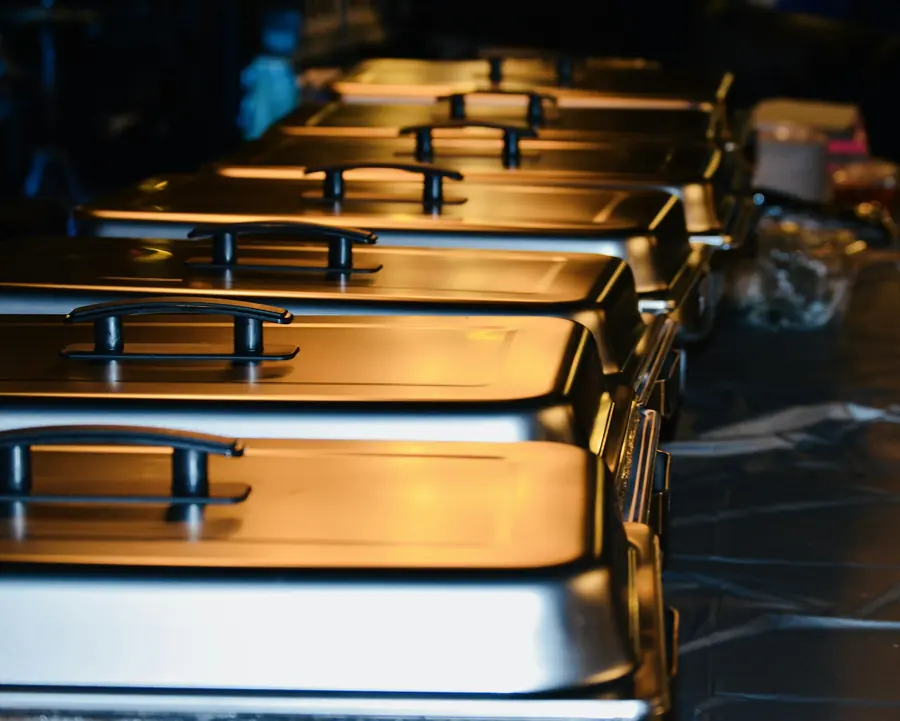
In practice that means keeping hot food hot in covered trays, keeping cold items cold until they go out, and refilling from the kitchen in smaller batches rather than putting everything on the table at once.
On the day
- Clear the space before the food arrives. A table with nothing on it, near a power point if anything needs warming.
- Be reachable. One phone number, one person, and that person is not presenting at the time of delivery.
- Put serving utensils out first. They are the thing most often missing at the moment the lids come off.
- Start the queue from both ends if the group is large. It halves the wait and costs nothing.
What happens to the food afterwards is worth planning too. Our guide to storing and reheating Mediterranean food covers which dishes come back well and how long they keep.
Leftovers
Plan for them, because there will be some. Have containers ready if you want people to take food home, and get anything perishable into a refrigerator rather than leaving it out through the afternoon — the same two-hour window applies to the end of an event as to the start.
Rice plates and grilled meats reheat well the next day. Dressed salads and anything fried do not, which is a reason to order those closer to the actual quantity you need.
Common mistakes
- Ordering to the invite list. Consistently produces 20 to 30 per cent too much food.
- Booking food for the start of the event. It should be ready shortly before people eat.
- Leaving dietary requirements to the day. They are easy to accommodate two weeks out and awkward on the morning.
- Forgetting the date is a holiday. Capacity on those weekends disappears earliest.
Ordering from us
You can see our catering options or contact us with a date and a rough headcount, and we can work backwards from there. For workplace events specifically, our guide to halal catering for the workplace covers the questions that come up around mixed teams, and our guide to halal catering in San Marcos covers formats and local logistics.
For everyday orders rather than catering, the channel matters too — the halal filter on a delivery app is chosen by the restaurant rather than verified by the platform.
Frequently asked questions
How far in advance should I order catering?
About two weeks for most events, with the final headcount confirmed two to three days before. Small orders can often be handled in a couple of days, and large or holiday-weekend events want three to four weeks because capacity goes first.
Can I change the numbers after I have ordered?
Usually yes, up to a point. Most kitchens expect an approximate figure at the time of booking and a firm one a few days out. Large reductions very late are harder, because the stock has already been ordered.
What time should I ask for the food to be ready?
Shortly before people will actually eat, rather than when the event starts. If there is an arrivals hour at the beginning, food delivered at the start of it will have been sitting for an hour before anyone touches it.
How long can catered food safely sit out?
The FDA advises discarding perishable food left out for more than two hours, reduced to one hour when the temperature is above 90 degrees Fahrenheit. Keeping hot food covered and hot, and refilling in smaller batches, is the practical way to manage that.
Should I order trays or individual portions?
Trays are more economical and look more generous on a table. Individual portions travel better, are quicker to hand out, and make dietary labelling much simpler. For a seated event or anything where people collect and go, individual portions usually work better.
Two weeks for the order, three days for the headcount, and food ready shortly before people eat. Most catering goes smoothly on those three decisions alone.
Got a date in mind? Tell us the headcount and we will work back from there.