

Mediterranean menus carry a few allergens more consistently than most cuisines, and two of them — sesame and tree nuts — are often invisible in the dish description.
This is a guide to where they typically appear and what to ask. It is not a safety assessment of any particular dish or restaurant: only the kitchen serving you can tell you what is in your food.
The short answer
Sesame is the one to know about. It is in tahini, which is in hummus and baba ganoush, and it appears in za’atar and on bread. Dairy is common through yogurt sauces and feta. Wheat is in every flatbread. Always tell the restaurant directly rather than working it out from the menu.
Sesame: the one people miss
Sesame became the ninth major food allergen in the United States under the FASTER Act, which means packaged foods must declare it. Restaurants are not held to the same labelling rules, though their suppliers are.
On a Mediterranean menu, sesame turns up in more places than its name appears:
- Tahini, which is ground sesame, and therefore in hummus, baba ganoush and many dressings
- Za’atar, a herb blend that frequently contains sesame seeds
- On bread, both baked in and scattered on top
- In sauces, where tahini is used as a thickener rather than as a headline ingredient
The National Restaurant Association’s own guidance on identifying sesame in a kitchen gives a sense of how widely it is used.
The others worth raising
Tree nuts
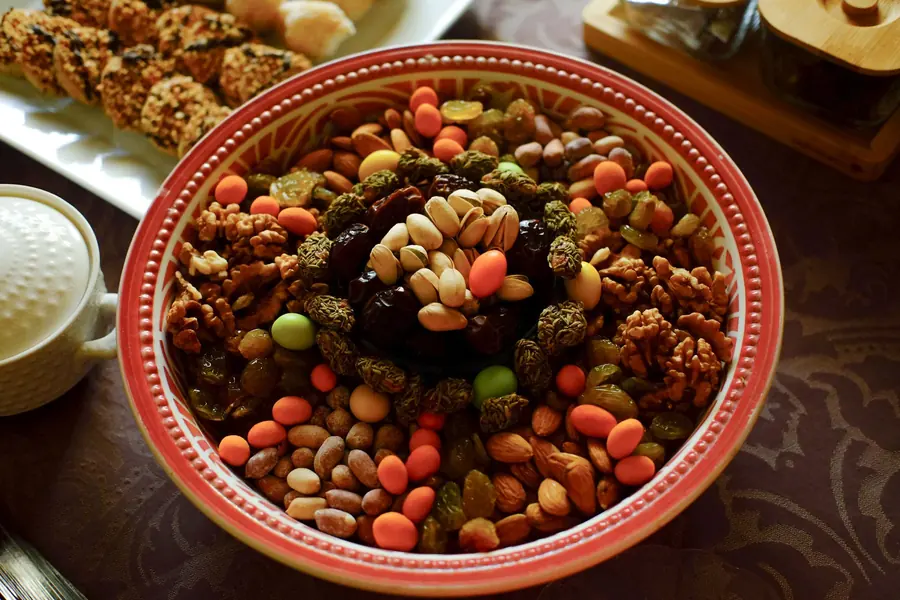
Pistachios, pine nuts, walnuts and almonds appear in rice dishes, on top of hummus, in some koftas and throughout the dessert menu. Pine nuts in particular are used as a garnish and rarely mentioned in a description.
Dairy
Yogurt sauces such as tzatziki, feta in salads, and butter or ghee brushed onto bread and rice. Dairy is one of the easier ones to ask about because it is usually visible, but the butter on bread and rice is not.
Wheat and gluten
Flatbread, pita and bulgur in tabbouleh are the obvious ones. Less obvious: some koftas and falafel mixes use breadcrumbs or flour as a binder, and some sauces are thickened with flour.

Eggs, fish and shellfish
Less common in this cuisine but not absent. Egg appears in some enriched breads and pastries. Fish and shellfish are limited on most inland Mediterranean menus but do appear, and shared fryers are the main concern rather than the dishes themselves.
Where allergens typically appear
| Allergen | Typically found in | Easy to miss in |
|---|---|---|
| Sesame | Hummus, baba ganoush, tahini sauce | Za’atar, bread toppings, dressings |
| Tree nuts | Desserts, rice dishes | Garnishes such as pine nuts |
| Dairy | Tzatziki, feta, yogurt sauces | Butter or ghee on bread and rice |
| Wheat | Pita, flatbread, tabbouleh | Binders in kofta and falafel |
| Egg | Pastries and enriched breads | Some batters and glazes |
This table describes what is common in the cuisine generally. It is not a statement about any particular restaurant’s recipes.
Why menu descriptions are not enough
A menu describes a dish so you can decide whether you want it. It is not an ingredient declaration, and it is written to be short. Garnishes, binders, finishing oils and the contents of a sauce routinely go unmentioned.
The same fryer raises a halal question as well as an allergen one, and asking once covers both. Our guide to whether french fries are halal works through shared oil and what a coating can legally contain.
The fryer question
Shared frying oil is the single biggest practical risk in this cuisine, because falafel, fries and occasionally fish come out of the same equipment in many kitchens.
It is also the question people least often think to ask. If a shared fryer would be a problem for you, raise it specifically rather than asking whether a dish “contains” something.
What “gluten-free” means, and where the word stops
Gluten is the one allergen on this page where the same two words mean different things depending on where they are printed, and it is worth knowing which version you are reading.
On packaged food the term is defined in federal regulation. 21 CFR 101.91 defines a gluten-containing grain as wheat, rye, barley “or their crossbred hybrids”, and requires that for a gluten-free claim, “any unavoidable presence of gluten in the food bearing the claim in its labeling is below 20 ppm gluten”. The same section applies that standard to “no gluten”, “free of gluten” and “without gluten”, and deems a food misbranded if it carries the claim without meeting it.
Read the operative wording closely and one phrase repeats throughout: in its labeling. What the regulation governs is the label a manufacturer puts on a package. A menu is not a label, so “gluten-free” written on one is the kitchen’s own description of a dish rather than a regulated claim measured against a ceiling.
That is not a reason to distrust a menu. It is a reason to ask what the description is based on, because the honest answer varies — sometimes it means the recipe contains no wheat, and sometimes it means rather more than that.
Where the wheat actually is
Flatbread, pita and the bulgur in tabbouleh are the obvious ones, and they are not usually what catches people out.
- Binders. Some kofta and falafel mixes use breadcrumbs or flour to hold them together.
- Thickened sauces. Flour is used in some sauces where it plays no part in the flavour and earns no mention.
- Breaded and battered items. Anything crumbed, and the coating on some fried items.
- Shared oil. A fryer that has cooked breaded food carries what came off it.
- Seasoning blends and marinades. Soy-derived and malt-derived ingredients both start from gluten grains.
| Dish | Gluten in the recipe? | What still needs asking |
|---|---|---|
| Hummus | Not normally | What it arrives with, and whether bread has been in it |
| Falafel | Sometimes, as a binder | The binder, and the fryer |
| Rice plates | Not normally | The sauce, the seasoning, and whether bread comes alongside |
| Grilled meat | Not normally | The marinade and any spice blend |
| Salads | Not normally | Croutons, pita chips, and bulgur in tabbouleh |
| Fries | Not normally | The fryer, and any coating |
We can tell you what goes into a dish and how it is prepared. Whether that is acceptable for coeliac disease or for a wheat allergy is a judgement for you to make, and one worth making with medical advice rather than from a menu.
Bread is where most of the wheat on this cuisine sits, and our guide to pita, naan and flatbread covers what tends to arrive with what. The grain in the salads is easier to miss — our guide to Mediterranean salads sets out which of them are built on bulgur or bread rather than leaves.
How to ask well
- Say it at the point of ordering, not after the food arrives, and to the person taking the order rather than to the table.
- Name the allergen rather than asking for something “without nuts” in general.
- Ask about preparation, not just ingredients — shared fryers, shared utensils and shared surfaces.
- Ask again on a repeat visit if the dish or the supplier may have changed.
FARE, the food allergy research and education non-profit, publishes practical guidance on dining out with allergies that is worth reading if this is new to you.
Allergens in a group or catering order
Group orders are where allergen management most often breaks down, and the failure is usually organisational rather than culinary.
- Raise it when you book, not on the day. Anything needing separate preparation has to be planned into the kitchen’s schedule.
- Ask for the affected portion to be packed separately and labelled, rather than relying on it being identifiable on a shared table.
- Brief whoever is serving. A tray moved between dishes with the same spoon undoes careful preparation.
- Tell the guest what you asked for, so they can make their own judgement rather than assuming it was handled.
Asking us
We would much rather answer a question than have you guess from a menu description. If you or someone in your group has an allergy, get in touch and tell us — before you order if you are planning a group meal, and at the counter if you are ordering on the day.
That applies to catering too. If you are arranging food for a group, flag allergens when you book rather than on the day, since anything needing separate preparation has to be planned for.
Wheat is not the only thing worth reading a bread label for. Our guide to bread covers the dough conditioners and emulsifiers that appear alongside it, and why their origin is not disclosed.
Frequently asked questions
Does Mediterranean food usually contain sesame?
Very often. Sesame is the base of tahini, which is in hummus, baba ganoush and many sauces, and it also appears in za’atar and on bread. If you have a sesame allergy, assume it is present until the restaurant confirms otherwise.
Is hummus safe with a sesame allergy?
Traditional hummus contains tahini, which is ground sesame. Some versions are made without it, but you should never assume — ask the restaurant about the specific recipe and about shared equipment.
What should I ask about at a Mediterranean restaurant if I have a nut allergy?
Ask about garnishes as well as ingredients. Pine nuts, pistachios and almonds are commonly used to finish rice dishes, hummus and desserts, and are rarely mentioned in a menu description.
Are shared fryers a problem?
They can be. Falafel, fries and sometimes fish are cooked in the same oil in many kitchens. If shared oil would be a problem for you, raise it specifically rather than asking only about ingredients.
Can a restaurant tell me a dish is allergen-free?
A restaurant can tell you what goes into a dish and how it is prepared. Whether that is acceptable for your particular allergy is a judgement for you, and for medical advice you should speak to a qualified professional.
Is Mediterranean food gluten-free?
A lot of it is built on ingredients that contain no gluten — chickpeas, rice, grilled meat, vegetables and olive oil — but the cuisine also puts flatbread on almost every table, uses bulgur in tabbouleh, and sometimes uses flour as a binder or a thickener. Treat it as a cuisine with many naturally gluten-free dishes rather than as a gluten-free cuisine.
Does gluten-free on a menu mean the same as on a packet?
No. The federal definition, including the below-20-ppm ceiling, applies to the labeling of packaged food. A menu is not a label, so the phrase there is the kitchen’s own description of a dish rather than a regulated claim, and it is worth asking what it is based on and how the dish is prepared.
The useful habit with this cuisine is to assume sesame until told otherwise, and to ask about the fryer as well as the recipe.
None of this is a substitute for talking to the kitchen. Menu descriptions are written to describe a dish, not to list everything in it.
Tell us about any allergy and we will tell you what we can.